Views: 0 Author: Site Editor Publish Time: 2026-03-12 Origin: Site
In the world of industrial packaging, selecting the correct containment method is the cornerstone of logistics efficiency and product safety. Companies across the globe rely on specialized plastic films to secure goods for transport, protect them from environmental hazards, and ensure they reach the end consumer in pristine condition. However, a frequent point of confusion for many warehouse managers and procurement specialists is the distinction between shrink film and stretch film. While both are polymer-based materials used for wrapping, their physical properties, application methods, and functional purposes are fundamentally different.
The primary difference between shrink film and stretch film lies in their reaction to heat and tension. Shrink film is designed to shrink tightly around an object when heat is applied, typically using a shrink tunnel, making it ideal for individual product packaging and tamper evidence. In contrast, stretch film is an elastic material designed to be pulled and stretched around palletized loads to provide load stability through elastic recovery without the need for heat.
Understanding these nuances is vital for optimizing your packaging line, reducing material waste, and ensuring that your machinery—whether it is a shrink tunnel or a high-speed pallet wrapper—is utilized to its full potential. Choosing the wrong material can lead to damaged goods, increased labor costs, and inefficient throughput.
This comprehensive guide will break down the technical specifications of both materials, explore their ideal use cases, and provide a detailed comparison to help you make an informed decision for your business operations.
What Is Shrink Film?
What Is Stretch Film?
What Is The Difference Between Shrink Film And Stretch Film?
Which Type Of Film Should You Use?
Advanced Equipment: The Role Of The Shrink Tunnel

Shrink film is a versatile packaging material made of polymer plastic that, when heat is applied by a shrink heat tunnel machine, shrinks tightly over whatever it is covering.
Shrink film, often referred to as shrink wrap, is most commonly composed of polyolefin, PVC, or polyethylene. The manufacturing process involves "orienting" the molecules; the film is stretched while hot and then cooled quickly. This "sets" the film in its stretched state. When the end-user applies heat via a heat shrink tunnel with conveyor, the plastic's memory is triggered, causing the molecules to return to their original, smaller state. This results in a tight, clear, and protective layer that conforms perfectly to the contours of the product.
This material is a staple in the retail and food industries. Because it can create a hermetic or near-hermetic seal, it is excellent for protecting products from moisture, dust, and dirt. Furthermore, a heat shrink tunnel for bottles is frequently used to apply multi-pack sleeves or tamper-evident seals on beverages and pharmaceuticals. The clarity of high-quality polyolefin shrink film also enhances the visual appeal of products on retail shelves, allowing consumers to see the item while knowing it hasn't been handled or compromised.
Beyond aesthetics, the structural integrity provided by a shrink tunnel application is significant. When the film shrinks, it becomes very taut and rigid. This rigidity helps in bundling multiple items together—such as a "buy one get one" promotion or a 24-pack of canned soda—ensuring they stay grouped during shipping and handling. The use of a shrink tunnel ensures that the heat is applied uniformly, preventing holes or uneven shrinking that can occur with manual heat guns.
Stretch film is a highly elastic plastic film, usually made from Linear Low-Density Polyethylene (LLDPE), that is wrapped around items to keep them tightly bound together using its inherent elastic recovery.
Unlike shrink film, stretch film does not require a shrink tunnel or any heat source to function. Instead, its effectiveness comes from its "stretchability." When the film is pulled around a pallet of goods, it wants to return to its original size. This creates a powerful gripping force known as "clamped load" or "elastic memory," which holds the items securely in place. It is the primary choice for palletizing goods because it can withstand the rigors of long-haul trucking and warehouse stacking.
There are several varieties of stretch film, including cast stretch film (known for excellent clarity and quiet unwind) and blown stretch film (known for its high puncture resistance and strength). Because stretch film is applied under tension, it is particularly effective at securing heavy or irregularly shaped loads that might shift during transit. It provides a level of friction between the layers of film that prevents the load from sliding off the pallet.
The application of stretch film can be done manually for low-volume operations or via semi-automatic and fully automatic pallet wrapping machines for high-volume environments. While it does not provide the same crystal-clear "retail look" as a product processed through a shrink tunnel, it offers superior UV protection (in opaque versions) and moisture resistance for bulk shipments. It is essentially the "industrial-strength" version of the cling wrap you might use in a kitchen, engineered to hold thousands of pounds of industrial equipment or consumer goods.
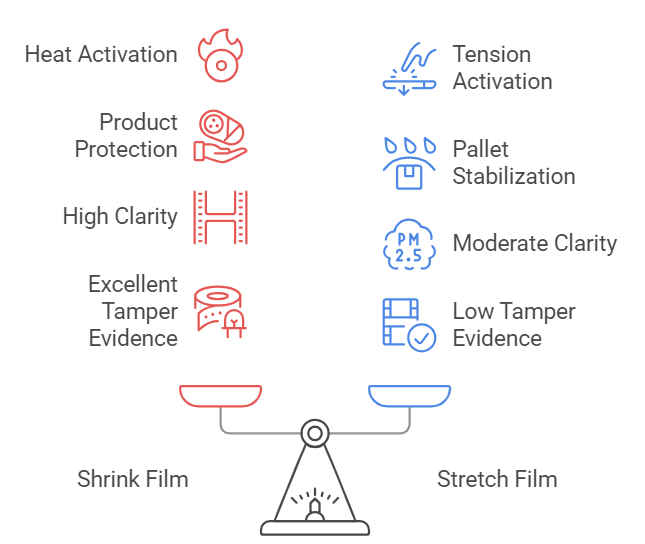
The fundamental difference between these two materials is that shrink film requires a heat source like a shrink tunnel to create a tight seal through contraction, whereas stretch film relies on mechanical tension and elasticity to secure loads.
To better understand how these materials differ in a professional B2B environment, we can compare them across several key categories:
| Feature | Shrink Film | Stretch Film |
| Primary Material | Polyolefin (POF), PVC, PE | LLDPE |
| Activation Method | Heat (via shrink tunnel) | Tension / Stretching |
| Main Purpose | Individual product protection/Display | Pallet stabilization / Bulk transport |
| Common Equipment | shrink heat tunnel machine | Pallet Wrapper / Hand Stretch Tool |
| Clarity | High (Glossy and Transparent) | Moderate (Can be hazy or opaque) |
| Tamper Evidence | Excellent (Film must be torn) | Low (Can be re-wrapped) |
The application process is where the operational costs differ significantly. For shrink wrapping, you must invest in a heat shrink tunnel with conveyor. The product is placed in a bag or a loose sleeve of film and then passed through the shrink tunnel, where circulating hot air causes the film to snap to the product's shape. This is a high-speed process perfect for consumer goods. Stretch wrapping, however, involves rotating a pallet on a turntable or moving a wrap arm around the pallet. There is no heat involved, making it safer for flammable products or items sensitive to temperature changes.
Furthermore, the protective qualities serve different masters. Shrink film is your best friend for "primary" or "secondary" packaging—the packaging the consumer sees. It protects against "shelf wear." Stretch film is for "tertiary" packaging—the shipping stage. It protects against the vibrations of a truck and the movements of a forklift. While a shrink tunnel can be used for large pallets (using heavy-duty shrink wrap), it is much less common than stretch wrapping due to the high energy costs and specialized equipment required for such large-scale heating.
Determining the right film depends on whether your priority is the protection and presentation of individual retail units or the stability and containment of bulk palletized shipments.
If you are a manufacturer of consumer electronics, food products, or cosmetics, you should almost certainly use shrink film. The professional finish provided by a shrink tunnel is unmatched. It prevents dust from settling on the product and provides a clear signal to the customer that the item has not been opened. For example, a heat shrink tunnel for bottles is the industry standard for securing multi-packs of water or juice. If your product is sold on a shelf, shrink film is the way to go.
On the other hand, if your primary goal is to move 50 boxes of product from a warehouse to a distribution center without them toppling over, stretch film is the correct choice. It is faster to apply to a full pallet and requires no heat, which is a major advantage in high-volume logistics. Stretch film is also much better at handling "protrusions" or sharp corners on a pallet, as the film can stretch around them without puncturing, whereas shrink film might become brittle or tear if stretched too thin over a sharp edge in a shrink tunnel.
Finally, consider the equipment footprint. A shrink heat tunnel machine and a heat shrink tunnel with conveyor require a dedicated power supply and space on the production floor. Stretch wrapping can be done with a simple hand-held dispenser if space is at a premium. However, for a fully automated line, integrating a shrink tunnel can significantly increase your parts-per-minute (PPM) rate, making it a highly profitable long-term investment for high-growth B2B companies.
The heart of any professional shrink-wrapping operation is the shrink tunnel. This machine is designed to provide a controlled environment where temperature and airflow are precisely managed. Without a high-quality shrink heat tunnel machine, the film may shrink unevenly, resulting in "dog ears" (un-shrunk corners) or "fish eyes" (round wrinkles), which detract from the product's appearance.
Modern heat shrink tunnel with conveyor systems are designed for efficiency. They use insulated chambers to retain heat, reducing energy consumption. The conveyor speed can be synchronized with the wrapping machine to create a seamless flow. For specialized industries, a heat shrink tunnel for bottles might utilize steam instead of hot air to provide a more uniform shrink on high-contour containers, ensuring that labels remain perfectly aligned and readable.
Investing in a shrink tunnel also allows for the use of various film types, such as cross-linked polyolefin, which requires higher temperatures but offers exceptional strength and clarity. By fine-tuning the settings on your shrink heat tunnel machine, you can achieve a "drum-tight" finish that not only protects the product but also reinforces the packaging, sometimes even allowing for a reduction in the thickness of the secondary cardboard box, further saving on material costs.
Productivity: Utilizing a shrink tunnel automates a labor-intensive process, allowing for thousands of units to be processed per hour.
Consistency: Unlike manual heat guns, a heat shrink tunnel with conveyor provides 360-degree heat distribution for a flawless finish.
Versatility: From a heat shrink tunnel for bottles to large-scale industrial tunnels, the technology scales with your business needs.
Security: The tight seal created by the shrink tunnel is an excellent deterrent against tampering and environmental damage.
In conclusion, while both films are essential in the packaging world, they serve different masters. Stretch film is the workhorse of the warehouse, holding the world's pallets together with its elastic strength. Shrink film, powered by the precision of a shrink tunnel, is the guardian of the individual product, ensuring safety, clarity, and a professional presentation that builds consumer trust. By understanding these differences and investing in the right shrink heat tunnel machine technology, your business can optimize its packaging process for maximum efficiency and minimum waste.


